



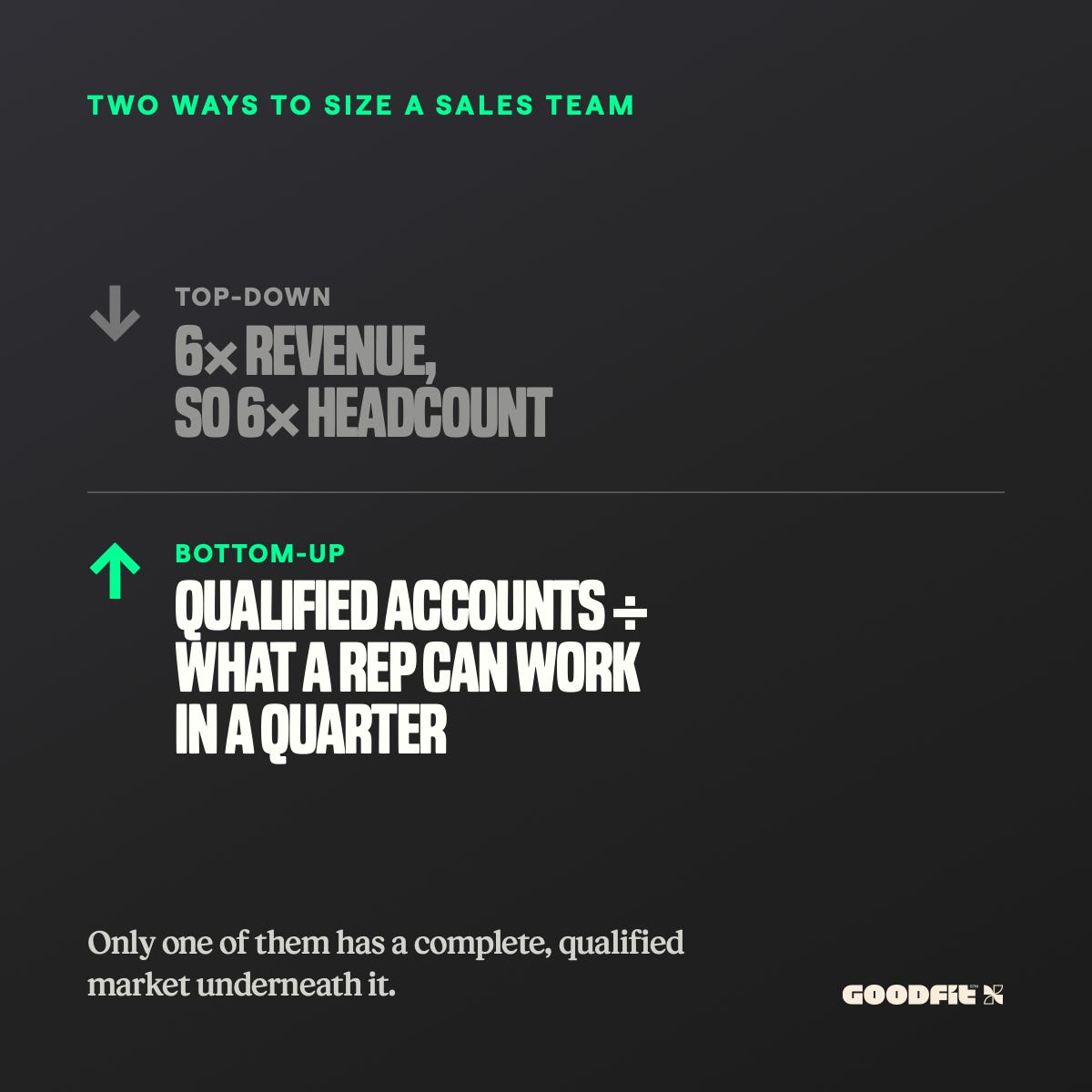
Most headcount numbers get built by a top-down approach. In other words, taking the revenue target, dividing it by the average AE quota, and whatever comes out becomes the new headcount number. Nobody tests whether that many qualified accounts actually exist for those reps to sell into, or whether the top of funnel is able to create sufficient opportunities for these AEs to hit their quotas.
The problem is that they’re not realistic headcount plans. They start from what the business wants to achieve, rather than from how many qualified accounts actually exist, how much pipeline can be generated, how many of them one rep can realistically work, and what’s left once you know that.
Balancing these often conflicting plans is what you need to achieve before that number goes anywhere near a board. This playbook walks through Adam Kay’s process on how to build a headcount case the way you’d build any other resourcing decision: by testing it against real accounts, real pipeline math, and real cost.
Key terms
Top-down headcount plan: a plan that divides a revenue target by average quota, without testing whether the market can support the result.
Serviceable Obtainable Market (SOM): the portion of your qualified market you can realistically reach and convert with your current team, motion and constraints.
Capacity unit: the number of qualified accounts one rep can properly work in a quarter, based on what your best reps achieve today.
Expected value: an account’s predicted win rate multiplied by its predicted contract value.
Revenue trigger: a pre-agreed point that slows hiring and spend if growth falls behind plan.
Capacity trigger: a pre-agreed point that tests whether the existing team can absorb more before the next hire.
Why this matters
Adam Kay, CRO at Goodfit, has been on the other side of this exact conversation. Early in his career, he joined a company where the board had signed off on a plan to grow from $3M to $20M ARR in a year - built entirely top-down.
A $1M quota per rep, an assumed attainment rate, and a headcount number that fell out of the division. No one had checked whether the market could actually support it. The existing team of three reps was already attaining only 40-50% of quota, and the plan called for hiring seventeen more on the same assumptions.
“The top down numbers worked, but the bottom up ones didn’t. We didn’t know how big our market was. We didn’t know which accounts were likely to come into the market, and we didn’t really have a repeatable process by which we could confidently say we knew how to generate enough pipeline for a rep to get the coverage they needed to hit their quota.”
- Adam Kay, CRO @ Goodfit
The board hadn’t done anything unusual. They’d done what most do - taken a growth target, assumed the only lever was headcount, and built the plan backwards from there.
A missing piece was to test whether enough qualified accounts existed to feed the reps that plan was about to hire.
“As CRO, I couldn’t put my name on something I didn’t believe in - that I knew it wasn’t going to work. So I said it plainly. As the revenue owner, when you come into a business and say, ‘okay, I’ll go and hire seventeen reps’ - you’re signing off on the plan. You’re basically saying if this doesn’t work, fire me, because I wasn’t good enough. I couldn’t sign off on this knowing it wouldn’t work.”
Starting from growth expectations
The starting point for most headcount plans is the growth number you’re expected to hit. 3x, 2x, whatever the board’s expecting. Headcount is just supposed to fall out of that automatically. Divide the gap by what a rep can sell, and there’s your number.
Adam walks through how that waterfall gets built:
“We’re VC-backed, so there’s an expectation of a certain amount of growth each year so we can raise a good round, call it 3x. Let’s say we end this year at 4 million ARR, which means next year we want to get to 12. That’s an incremental 8 million.
Now I want to know where that 8 million is coming from. We’ve got renewals, we’ve got expansion, and we’ve got net new. If I’ve got 120% net revenue retention, I can expect existing customers to deliver a chunk of that 8 million before I’ve won a single new logo. Whatever’s left has to come from net new.”
Only once that remainder is isolated does headcount enter the conversation, and even then, it’s a second-order calculation:
“If an AE generates a million a year at quota, and I need 7.7 million from net new, that’s eight AEs fully ramped. Maybe I model a bit of attrition and underperformance, so it’s ten or eleven. That’s the top-down number. But then I ask - are we creating enough pipeline for eleven AEs to hit a million dollars each? That’s a different question entirely.”
A growth target and an average quota will always produce a number. Whether that number is defensible depends on whether the pipeline, funnel metrics and the market underneath it, can actually support it.
How to produce a defensible headcount number
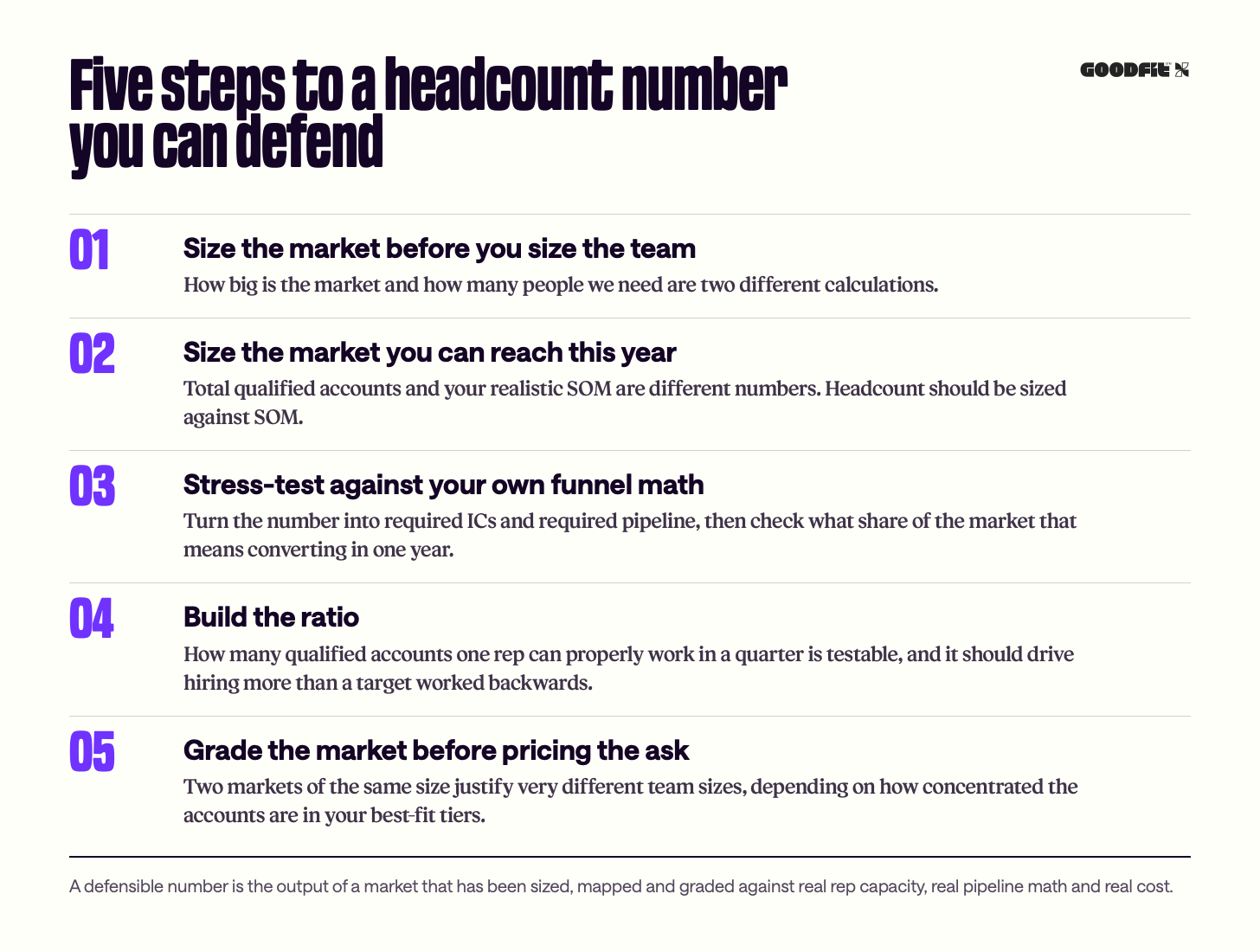
A defensible headcount number is the output of a market that’s been sized, mapped and graded against real rep capacity, real pipeline math, and real cost. Here’s the approach:
Separate “how big is the market” from “how many people we need.” These get collapsed into one number more often than not, and conflating them is the fastest way to a mis-sized plan.
Size the market you can actually reach this year, not the market that exists in theory. Total qualified accounts and your realistic Serviceable Obtainable Market (SOM) are different numbers, and headcount should be sized against the second one.
Stress-test the number against your market saturation. Turn a headcount figure into required ICs and required pipeline, then check what share of your total market that requires converting in a single year. If it’s an implausible share of the market, the number is wrong.
Build the ratio, not the round number. How many qualified accounts can one rep properly work in a quarter is a number you can test, and it should drive the hiring plan more than a target you’re working backwards from.
Treat the ratio as a live variable, not a constant. AI and process change are already moving how many accounts a rep, BDR, or AM can properly carry. A ratio set once at the start of the year and never revisited is likely missing those impacts.
Grade the market before you price the headcount ask. Two markets of the same size can justify very different team sizes, depending on how concentrated the accounts are in your best-fit tiers.
Bring the board a range and a pre-agreed trigger. Decide what evidence would justify the next hire before you’re in the room defending a number you chose under pressure. A revenue trigger protects against running out of money. A capacity trigger tests whether the team can absorb more before the next hire. Decide what evidence would justify the next hire, and which of these two questions that evidence is actually answering.
This is the same discipline Goodfit applies to market sizing - sizing the qualified market first, then using that to answer the resourcing question.
The revenue headcount planning framework
Step 1: Separate the size question from the resourcing question
Every headcount conversation should answer two questions.
The first is a market question. How many qualified accounts exist that we could realistically sell to?
For companies selling multiple products, this question needs to be answered for each product where the buyer, use case or qualification criteria differ. Applying one blended definition can obscure the size and quality of each product’s actual market.
The second is a resourcing question. Given that market, how many people do we need to work it properly?
Diagnostic question: If someone asked you right now how many qualified accounts exist for your team to sell into - not accounts in the CRM, not a TAM estimate from a data provider, but accounts that pass your actual commercial, serviceability, and structural criteria - could you answer without hedging?
If the answer is yes, run the same process as Adam runs below and ask yourself, does your plan sound realistic?:
“If I need eight AEs to hit a million each, at a 20% win rate and a 60k average deal size, each rep needs about 83 deals in pipeline a year. Times eight reps, that’s over 900 qualified deals. If I’m converting ICs to opportunities at 50%, I need almost 2,000 ICs. Out of a 10,000-account market, that means I’m converting 20% of my entire market into an IC in a single year. That doesn’t feel realistic. There’s a problem with the plan.”
- Adam Kay, CRO @ Goodfit
The lever isn’t always headcount - it can be win rate, deal size, or the market itself:
“What happens if I increase my win rate to 30%? That means fewer ICs, fewer deals needed. What if I go after bigger deals and lift ACV from 60 to 90k? As a revenue leader, I’m looking at what’s true today, then asking which of these metrics I can actually move.”
Action: Turn your headcount number into required ICs and required pipeline using your actual win rate and deal size. Divide that by your total qualified market. If the result asks you to convert an implausible share of your market into an IC within a single year, the lever to pull isn’t headcount - it’s win rate, deal size, or market size itself.
Step 2: Build the ratio
Once the market size is real, the next step is working out how many qualified accounts one rep can properly work, given your actual sales cycle, deal complexity, and the amount of research and personalization each account needs.
This ratio is almost never written down anywhere, and may change when you’re focusing on your best-fit accounts. In one Goodfit customers’ case, a rep exhausted their entire allocated book of accounts within a single month - the team hadn’t sized how quickly a rep could work through a well-defined pool of best-fit accounts, so the allocation ran out well before the review cycle that was meant to refresh it.
Action: Take your best reps, look at how many qualified accounts they’re actually able to work properly - not just touch, but work - in a quarter, and use that as your capacity unit.
Multiply it out against your top-tier market size, and you have a defensible cap for how many reps that tier can support before the next one needs to be brought into scope.
That’s the ratio question for AEs. The same logic applies across roles - AMs, BDRs, AEs - even though the unit changes each time. Accounts per AM, ICs per BDR, deals per quarter for an AE. And it’s a live variable - AI and process change are already moving what “properly worked” means for any of them.
“How is AI shaking up this model? Today it’s one account manager for twenty clients, one BDR generating fifteen ICs a month. But do I need one BDR for fifteen ICs, or can I get one BDR to thirty? Can an AE do more than a million because I can hand them more deals and hire fewer people? The traditional models are out the window right now, and I don’t know the answer yet.”
Adam’s approach is to prove it out hire-by-hire:
“I’m not hiring twenty AMs tomorrow. I’ll hire one or two under the current model, see if we get to forty customers before needing the next one, then ask, can we push that to fifty with what we’ve learned? My hiring plan pivots through the year. If I can save money by making the team more productive, that’s a win everyone wants.”
Step 3: Grade the market before you price the headcount ask
The same total account count can justify very different headcount numbers depending on how those accounts are distributed across grade bands.
A market of 8,000 qualified accounts with 1,800 sitting in the top two grade bands supports a very different team size than a market of 8,000 accounts spread evenly across four tiers - even when the raw count is identical.
That’s because grading doesn’t just rank accounts, it tells you what motion each tier deserves.
A-grade and B-grade accounts justify a rep’s full attention, meaning deep research, personalised outreach, multiple touchpoints and real time spent per account.
Lower-grade accounts don’t justify that same investment, but they’re not dead weight either - they can run on a lighter, programmatic motion such as automated sequences, templated outreach, periodic check-ins to catch signals of movement, with a rep dipping in only when something changes.
This is what makes grading a headcount lever. A rep’s real capacity is “how many A/B-grade accounts can I properly work while the rest of the book runs on autopilot.” A market with 1,800 accounts concentrated in the top two tiers means a focused team can spend most of its time there, with lower tiers handled programmatically in whatever time is left.
A market where that same 1,800 is diluted evenly across four tiers has no equivalent pocket to concentrate on - reps end up splitting real attention across accounts that don’t all deserve it, because there’s no natural cutoff between “work this properly” and “let this run itself.”
Most teams don’t actually know their qualified market size, never mind what to do with it once they do. Adam shares the the question he hears revenue leaders get stuck on once they do have a number:
“If I’ve got a market of 30,000 accounts, how do I know the right amount of resource to go after them?”
Adam’s answer is in how that 30,000 breaks down once it’s graded by expected value (Expected Value = Predicted win rate × Predicted contract value), and how much of it can be handed to a programmatic motion versus how much needs a rep’s direct attention.
Goodfit’s own internal mechanism for proving this out is to look at the accounts a team’s reps have actually worked over the last several months, apply the tiering system retroactively, and compare the ARR outcome the team got against what they would have got working the same number of accounts in the top-tier band instead.
That comparison does more to justify or rule out a headcount ask than any growth-percentage math, because it isolates whether the constraint is genuinely headcount, or whether it’s that existing reps are spending high-touch time on accounts that should have been handed to a programmatic motion instead.
Step 4: Cost the ask against expected value
A headcount plan built on “revenue target divided by average quota” tends to rely on an assumption that every account in the pool converts at the same rate and closes at the same size. In practice, it doesn’t, and that’s exactly what expected value is built to capture.
EV isn’t deal size on its own, it’s deal size weighted by likelihood to convert, which means it’s a much sharper number to cost a hire against than a raw average.
Here’s the test. Take the fully-loaded cost of a new rep - OTE, ramp period, management overhead, and work out the minimum expected value, across the accounts they’d realistically be working, needed for that hire to pay for themselves within a reasonable window.
Then check that number against your top-tier grade bands. If the accounts in your highest grade band carry strong expected value, the hire is justified on volume alone. But if a grade band looks strong on raw deal size while actually carrying weak expected value, because conversion likelihood is low, or the accounts take too long to close, the headcount ask doesn’t hold up, no matter how many accounts sit in that tier.
This is also where a flawed grading model can be tested before it costs you a bad hire. If your qualification criteria still lean on a proxy that doesn’t correlate with real outcomes, the accounts you’re costing the hire against may not carry the expected value your model assumes.
Before pricing a headcount request, define the minimum expected value that makes a new hire’s ramp pay for itself, then confirm your top-tier grade band actually delivers it.
A rep’s cost is rarely the whole cost of the plan. A headcount ask that arrives isolated from the rest of the resourcing model is easy to push back on - it’s answering one part of a question the board is actually asking about the whole system:
“If I need eleven AEs, I know how much an AE costs, so I know the marketing spend needed to generate that number of ICs, how much travel we need if we’re doing more. This isn’t just a rep count - it’s the entire hiring cost. If I’m winning ninety customers, how many account managers do I need? How much solutions engineering? How many BDRs? What does the product need to do to deliver that - how many engineers, how many PMs? It all comes together in one plan.”
- Adam Kay, CRO @ Goodfit
Step 5: Bring the board a range and a pre-agreed trigger
A fixed headcount number is easy to push back on in a room. A range is harder to argue with, because it’s already built to move.
Instead of “we need five reps,” bring “three to five, depending on Q3 conversion in the top tier.” This is telling the board or leadership team upfront that the number moves with the evidence, so you’re negotiating within a range you already tested.
Decide in advance what would move you from three to five, whether it’s unworked accounts piling up in your top tier past a certain point, reps consistently over capacity, or expected value the current team can’t reach without more people.
In the room, this sounds like: “our top-tier market supports three to five reps. Here’s what happens at three, here’s the exact point where it becomes five.”
Not every hiring trigger works the same way, and it’s worth being explicit about which one you’re using. Adam distinguishes between two:
“The revenue trigger is about not running out of money - if we’re missing our targets, I need to know early enough to slow down hiring and spend, buy us runway to get back on the growth curve.
The capacity trigger is different. I’m assuming every twenty new customers we win, I need another account manager. I’ll probably start hiring at fifteen, because it takes time to ramp. But by the time I hit the next fifteen, have we actually tested anything - AI, process, tooling - that gives the existing team more capacity? If so, maybe I don’t hire at fifteen. Maybe I push it to twenty-five.”
This is easiest to see in account management, where the ratio is explicit - one AM per twenty accounts. The distinction matters for how a headcount ask gets framed. A revenue trigger is a guardrail against running out of money, a capacity trigger is a live experiment you’re allowed to update as you learn.
Before you finalise the number
A growth target will always produce a number. An average quota will always turn that number into a headcount plan. But you might find that number is more of a hindrance than a help if it’s not grounded in the reality of your market.
The version that holds up is the one with a market that’s been sized, a ratio that’s been tested against your best reps, a grade that tells you where to concentrate the team, and a cost that’s been checked against expected value.
This is the same starting point Goodfit gives revenue leaders - a graded, qualified market.
Charted Waters is Goodfit’s publication for revenue leaders, featuring practical playbooks and perspectives from the Goodfit team on how revenue leaders navigate their markets.
Read next

De-risking your 2027 revenue plan
Headcount is only one part of the plan. Adam Kay walks through the three pillars that make a revenue plan defensible: a dynamic market, graded accounts and expected value.
FAQs: headcount planning with data
Why doesn’t a revenue target divided by average quota work as a headcount plan? Because it assumes every account in the market converts at the same rate and closes at the same size, which is rarely true. It also skips the step of checking whether enough qualified, well-graded accounts actually exist to support the reps that math implies - the number can look precise without ever being tested against a real market.
What’s the difference between total qualified market size and Serviceable Obtainable Market (SOM)? Total qualified market size is every account that passes your qualification criteria. SOM is the portion of that market you can realistically reach and convert given your current team, motion, and constraints. Headcount should be sized against SOM, not the full qualified market - otherwise the plan assumes reach you don’t actually have yet.
How do I know if my accounts-per-rep ratio is realistic? Test it against what your best-performing reps are actually doing today, not an assumption from a sales methodology or a competitor’s public numbers. Look at how many qualified accounts they’re properly working - not just touching - in a quarter, and use that as your baseline capacity unit.
Should headcount be the same across every segment of our market? Not usually. A tightly graded, high-concentration segment can be resourced efficiently by a small, focused team. A segment where qualified accounts are spread evenly across grade bands, with no natural place to concentrate effort, typically needs more resource per account covered - or a different motion entirely.
How often should a headcount model be re-tested? On the same cadence as your market sizing, since the two are linked. A ratio or a SOM figure set at the start of a fiscal year and never revisited becomes a fiction the moment the market, the team’s capacity, or the product changes.
What’s the strongest evidence to bring to a board meeting? A comparison of actual outcomes against what the team would have achieved working a smaller number of properly graded, top-tier accounts instead. That comparison answers the question a headcount number alone never can: whether the constraint is genuinely headcount, or whether it’s that the accounts being worked aren’t the right ones.
How does Goodfit help with headcount planning specifically? Goodfit defines and grades the qualified market first, so headcount conversations start from a real account universe rather than a revenue target working backwards. By identifying how many qualified accounts exist, how they’re distributed across grade bands, and how many a rep can realistically work, Goodfit gives revenue leaders the evidence to size a team against the market that’s actually there - not the market a spreadsheet assumes.
Why does a headcount plan need to separate revenue triggers from capacity triggers? A revenue trigger protects against running out of money if growth falls behind plan - it’s about slowing hiring and spend early enough to preserve runway. A capacity trigger is about proving whether the existing team can absorb more before the next hire is made. Treating every hiring decision as a revenue trigger means committing to headcount that might not be needed; treating every one as a capacity trigger risks under-hiring into a market that’s ready to be worked.
Should a headcount plan assume AI-driven productivity gains upfront? Not usually. The more defensible approach is to treat productivity assumptions the same way you’d treat any other untested variable in the plan - hire in smaller increments, test whether the team can absorb more volume with the tools and process changes being made, and let the ratio move based on evidence rather than a number baked in at the start of the year.