


“Everyone’s got the same signals. When somebody raises funding or somebody moves jobs or somebody’s on your website, everyone gets that. So suddenly signals become very commoditised and generic.”
Adam Kay, CRO @ Goodfit
When Adam came back from Pavilion’s GTM 2026 in New York, one phrase summed up the mood among the revenue leaders he’d spent the week with: FUD. Fear, uncertainty and doubt.
Go-to-market is going through a period of significant change. Legacy growth models are being challenged, expectations are higher than ever, and the tooling available has exploded. Yet the AI era is still raising more questions than answers about strategy, tactics and tools. Everyone is trying to find a way to use the latest capabilities, and no one seems to have found the answers.
What struck Adam most was a shared frustration with sameness. New capabilities haven’t helped teams stand out. If anything, they’ve made everyone look the same - the same signals, content, the tactics.
Signals have become one of the most talked-about ideas in go-to-market, but Adam’s view is that most teams are using them the wrong way round. A signal only tells you that something happened at an account, it can’t tell you whether that account was worth acting on in the first place.
The only way to properly be able to action signals and gain a competitive advantage is to have properly mapped and graded your market first, so you know which signals to follow and how.
Key terms
Signal: an event at an account that suggests it might be ready to buy, such as a funding round, a job change or a visit to your website.
Qualified market: the full set of accounts that genuinely fit who you win with, defined by the conditions that create the problem you solve rather than by industry, company size and location.
Expected value: an account’s predicted win rate multiplied by its predicted ACV. It shows how much an account is worth pursuing relative to others.
Account grade: a tier assigned to each qualified account based on its expected value, used to decide how much time, attention and budget it gets.
Base layer: a mapped and graded view of your market that tells you which accounts fit, and what each one is worth, before any signal arrives.
Why do so many revenue teams feel like they’re doing the same thing?
Because, in many ways, they are. The tools available to go-to-market teams have multiplied, but most teams have access to the same ones, fed by the same data. Adam puts the scale of that change in perspective - in 2011, there were around 150 GTM tools on the market, by 2025, that number had passed 15,000.
That explosion has brought genuinely impressive capabilities, but at Pavilion GTM 2026, Adam heard the same concern again and again from revenue leaders - all this new technology hasn’t made it easier to stand out.
“There was a genuine sense that new capabilities have simply created a ‘more of the same’ amongst competitors in the industry, which has made differentiation even harder than before.”
When every team can buy the same tools and the same data, the advantage those tools once offered disappears. Everyone is fighting for the same attention, in the same places, triggered by the same events. Buyers have become very good at ignoring all of it.
Adam didn’t leave New York with a silver bullet, but he did leave with a conviction that in a period of this much change, the answer probably isn’t another tool. It’s going back to the principles that sit underneath all of them.
Why have signals stopped working?
Signal-based selling was meant to be the answer to spray-and-pray outreach. Instead of contacting every account on a list, you wait for a reason to reach out, then act on it. In principle, that’s sound. In practice, Adam sees a problem with how most teams are approaching it.
“Everyone is talking about signals. Signals, signals, signals. And everyone talks about, how can we get signals no one else has? Well, firstly, everyone’s got the same signals.”
When a company announces a funding round, it isn’t only your SDRs who see it. Every vendor tracking that account gets the same alert, on the same day, and many of them send a version of the same message. The buyer receives a wave of congratulations, all of them interchangeable.
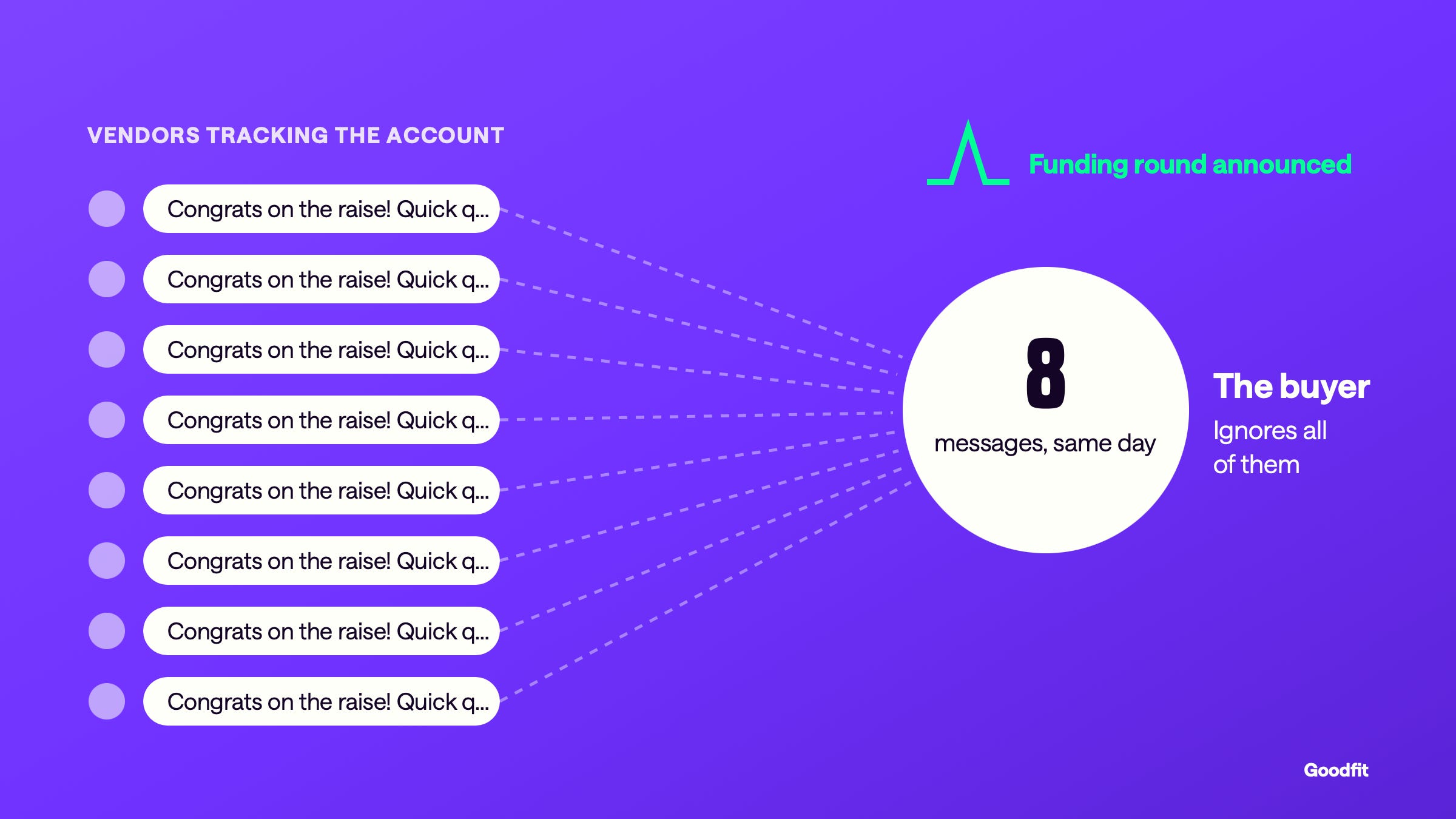
That’s why so many teams are now hunting for more unique signals, or concluding that signals simply don’t work. Adam’s view is that both responses miss the point. The problem isn’t that the signals are bad. It’s what they’re being asked to do.
In Goodfit’s terms, a signal is a data point - a single fact about an account. Useful, but raw. It tells you something happened. It doesn’t tell you what that means for your business, or what you should do about it. That still has to be worked out, and most teams are trying to work it out from the signal alone.
Why isn’t a signal enough to decide who to go after?
A signal tells you an account is showing activity. It can’t tell you whether that account was ever going to buy your product, or how much it would be worth if it did. That’s why, in Adam’s view, signals can’t be the starting point.
“People think they’ve done their ICP. People think they’ve done their mapping. And then they use signals to say which account should I go after.”
The trouble is that most teams’ view of their market isn’t as solid as they think. On average, 70% of the accounts in a B2B company’s CRM fall outside its qualified market, and B2B companies are missing around 60% of the accounts that match their qualification criteria from their CRM.
Point a signal tool at that CRM and you’ll get plenty of alerts. Most of them will be about accounts that were never going to convert, while many of the accounts you’d most like to win never trigger an alert at all, because you’re not watching them.
A funding round at a company that was never going to buy your product is still just a company that was never going to buy. An accurate signal on the wrong account is still a wasted action.
This is what Adam means when he says signals aren’t the starting point. They sit on top of something more fundamental. If that foundation is shaky, signals don’t fix it.
Why should the same signal get a different response?
Because not every account is worth the same to you. Two accounts can trigger an identical signal, but if one is worth far more than the other, they shouldn’t get the same treatment. You can only make that call if you know what each account is worth before the signal arrives.
Adam explains it with a simple scenario. Imagine two accounts in your market. One is a tier A account, with the highest expected value - a high predicted ACV and a strong chance of winning. The other is a tier D account, with a much lower ACV and a lower win rate. On the same morning, someone from each of them visits your website.
“If you don’t have that information beforehand, you treat them both the same. Whereas if you know these are two different value companies, your approach is probably going to be quite different, despite the signal being identical.”
Without a graded view of the market, both visits look the same in your tools. Both might get the same sequence, the same SDR follow-up, the same level of urgency. With it, the tier A visit warrants your best people and your fastest response, while the tier D visit might be better left to an automated programme.
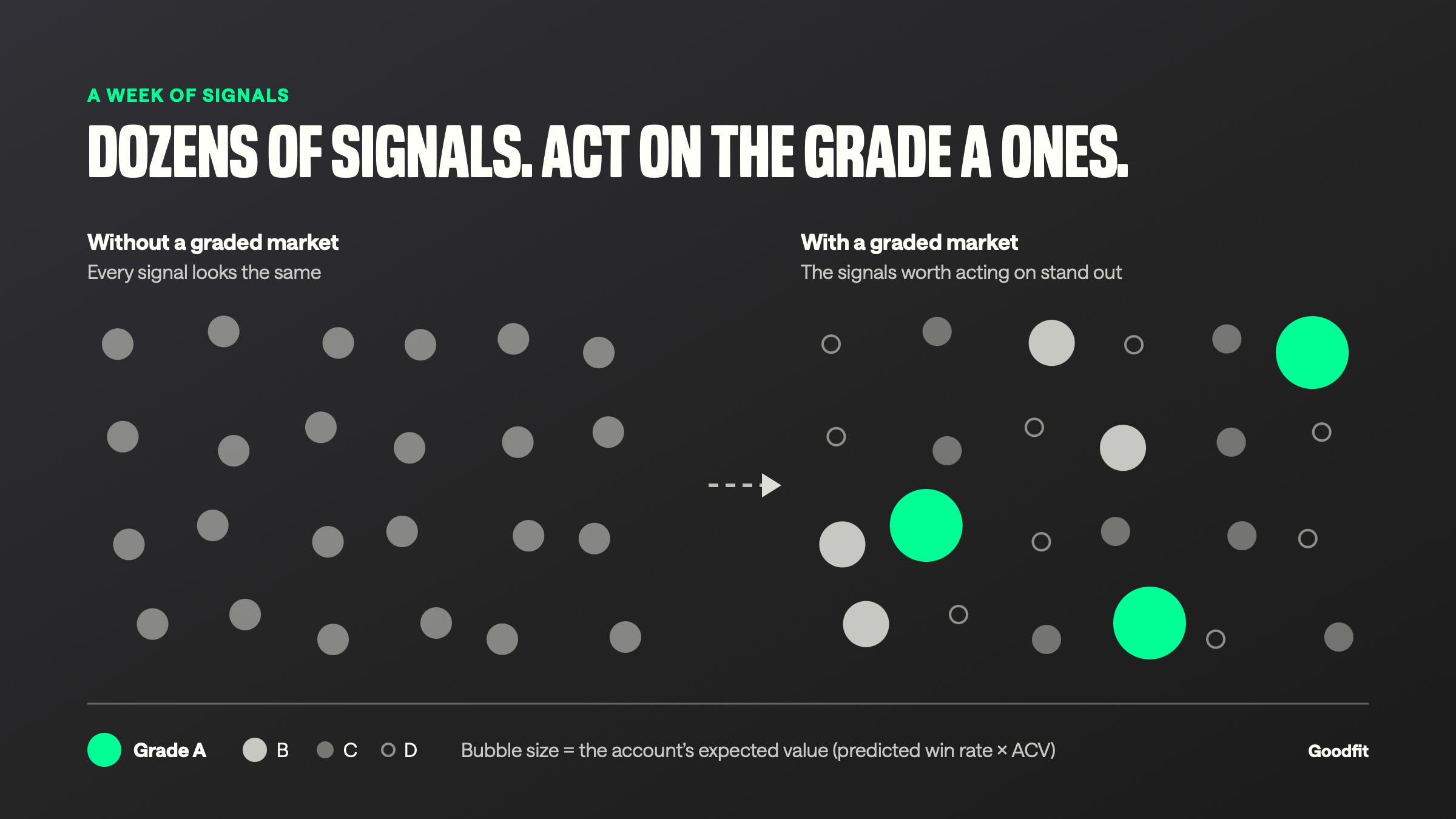
Adam also sees grading as what aligns sales and marketing around the same accounts, so budget follows value rather than volume.
“We’re not going to do ABM against tier three accounts. We’ll probably do an always-on programmatic. You want to be putting most costs behind the highest expected revenue you’re going to be getting.”
That’s the real job of the base layer. It doesn’t replace signals, but it can tell you what each signal is worth, so your team can respond in proportion.
“In order to get the most out of signals, you need to map and grade your accounts, to identify not just the right outbound approach, but the right response as well when something comes inbound or is marketing-influenced.”
If it’s this simple, why aren’t more teams doing it?
Most teams believe they’ve already built the foundation, and going back to check feels like admitting they got the basics wrong. So instead, they keep investing in the layer on top.
Adam is the first to say the idea itself shouldn’t be controversial. What makes it controversial is how few teams act on it.
“It’s controversial because not many people are doing it. People think they’ve done their ICP. People think they’ve done their mapping.”
He sees two reasons teams hold back, the first is that it feels too basic. After years of building revenue functions, revisiting who you sell to can feel like a step backwards. The second is momentum, when the whole industry is talking about signals, it’s hard to be the team that stops and looks at what sits underneath them.
“There’s a building blocks approach that a lot of people are reluctant to invest in, either because it feels so foundational that they’ll look stupid going back to it, or because they’re on this kind of crazy train which everyone else is on, of signals, signals, signals.”
That reluctance is understandable. But it’s also why the sameness Adam heard about at Pavilion persists. If every team builds on the same foundations, buys the same signals and acts on them the same way, nobody stands out. The teams that will get the most from signals are the ones willing to do the less glamorous work first.
What this means for revenue leaders
None of this is an argument against signals. Adam is clear that they matter.
“Signals are really important. But only once you know who the account is, and what that account is.”
The point is about order. Signals are a layer, and every layer needs something to sit on. Before any new capability can make a difference, a revenue team needs to be able to answer a few core questions with confidence - who do you sell to, where are those companies, how many of them are there, and how do you find them? Without those answers, signals have nothing to attach to, and every alert looks equally urgent.
That’s also where differentiation comes back. If everyone has the same signals, the advantage doesn’t come from the signal itself. It comes from what you already know when you get the signal - whether the account genuinely fits, what it’s likely to be worth, and how much of your team’s time it deserves. That knowledge isn’t something you can get from a traditional data provider.
Adam came away from Pavilion believing that in a period of this much change, the tried and tested principles might, ironically, be the way forward.
“The winners will be those that maintain focus on the core principles - building great teams, investing in your people and truly knowing your market as a foundational layer from which all of the innovation and modern capabilities can be deployed.”
Get the next one in your inbox
Signals are everywhere. Knowing which ones matter is rarer. Subscribe to Charted Waters for practical takes on mapping, grading and prioritising your market.
Read next

De-risking your 2027 revenue plan
The same base layer that makes signals worth acting on is what holds a revenue plan together. Here’s how Adam pressure-tests a plan beyond the headcount number, by knowing your qualified market, what each account is worth and who to reach at each one.
Frequently asked questions
Does signal-based selling work?
It can, but not on its own. According to Adam, signals only become useful once a team knows which accounts are in its market and what each one is worth. Without that base layer, signals generate activity against accounts that were never going to buy, and treat every alert as equally important.
Why are signals becoming less effective?
Because most teams now have access to the same ones. Funding rounds, job changes and website visits are available to every competitor at the same time, so signals have become commoditised. Adam’s view is that the advantage no longer comes from the signal itself, but from what you already know about the account when it arrives.
What should come before signals in a go-to-market strategy?
A mapped and graded view of your market. That means knowing every account that genuinely fits who you win with, and grading each by expected value (predicted win rate × predicted ACV), so you know how much each account is worth before any signal arrives.
Should every signal get the same response?
No. Adam argues that two accounts triggering an identical signal should be treated differently if they’re worth different amounts to your business. A high-value account might warrant your best people and a fast, personal response, while a lower-value one might be better suited to an automated programme.
How do signals and account grading work together?
Grading tells you what an account is worth. Signals tell you when something is happening at that account. Together, they let a team decide both who to prioritise and when to act, and match the response to the value of the account.
Why don’t more revenue teams build this foundation first?
Adam sees two reasons. Many teams believe they’ve already done it, and revisiting such a foundational step can feel like a step backwards. Others are caught up in the industry’s focus on signals and tools, and it’s hard to be the team that stops to look at what sits underneath.
Are signals still worth investing in?
Yes. Adam is clear that signals are really important. The question is order: signals deliver the most value when they sit on top of a qualified, graded market, rather than being used to decide which accounts to go after in the first place.
About Adam Kay
Adam Kay is CRO at Goodfit, the GTM intelligence platform that helps revenue teams define, map and grade their qualified market. He joined Goodfit after its Series A and has spent his career building sales engines at early-stage SaaS companies, including Paddle and Playroll. Adam regularly speaks about sales process design, ICP definition and how AI is changing revenue leadership.